Throughput with peak-mix honesty
Nominal tests/hour only matter when the morning panel mix, rerun rate, and autoverification rules are modeled together.
In-vitro diagnostics · Laboratory systems
Compare analyzer throughput, coefficient of variation, limit of detection, LIS messaging, and service assumptions before a hospital or reference laboratory commits to a configuration.

Procurement workbench
Figures below are planning ranges from the industry brief, not guarantees for every Nipro reference. Confirm IFU, assay menu, and regional labeling.
| Analyzer throughput | Plan against 600–2,000 tests/hour, then validate peak assay mix |
|---|---|
| Analytical verification | Limit of detection (LOD), coefficient of variation (CV), reportable range, method comparison |
| Information flow | LIS bidirectional orders/results, operator identity, downtime recovery |
| Boundary | Actual performance depends on assay, specimen type, calibration, and site workflow |
| CBC workflow | Map sample integrity flags, smear-review triggers, and manual differential load |
|---|---|
| Precision lens | CV targets by parameter; confirm local verification protocol |
| Traceability | Reagent lot, calibration, QC charts, and operator audit trail |
| Boundary | Clot, lipemia, and transport delay can shift flags independent of analyzer model |
| Menu fit | Match assay menu to clinic volume and reflex rules |
|---|---|
| Analytical sensitivity | Higher sensitivity can increase false-positive review when prevalence is low |
| Regulatory path | Confirm CE mark under IVDR 2017/746 or FDA 510(k) cleared status by reference |
| Boundary | Reagent open-vial stability and calibration interval govern usable capacity |
| LOD / LoQ | Document detection and quantification limits for each assay panel |
|---|---|
| Contamination control | Pre- and post-amplification zoning, unidirectional workflow, wipe tests |
| Software lifecycle | IEC 62304 class, version control, and change impact for result algorithms |
| Boundary | Specimen integrity and extraction recovery dominate analytical claims |
Portfolio snapshot
Start with the family that matches your assay mix. Open the catalog for live inventory, or inquire for IFU, throughput envelope, LIS notes, and service assumptions. Product detail pages are not used.
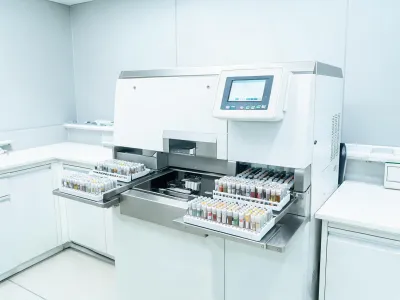 Clinical Chemistry Systems
Plan against 600–2,000 tests/hour, then validate LOD, CV, reportable range, and LIS bidirectional recovery for your peak panel mix.
Open catalog →
Clinical Chemistry Systems
Plan against 600–2,000 tests/hour, then validate LOD, CV, reportable range, and LIS bidirectional recovery for your peak panel mix.
Open catalog →
 Hematology & CBC Workflow
Map smear-review triggers, parameter-level CV targets, and CLSI EP05 verification ownership before go-live.
Open catalog →
Hematology & CBC Workflow
Map smear-review triggers, parameter-level CV targets, and CLSI EP05 verification ownership before go-live.
Open catalog →
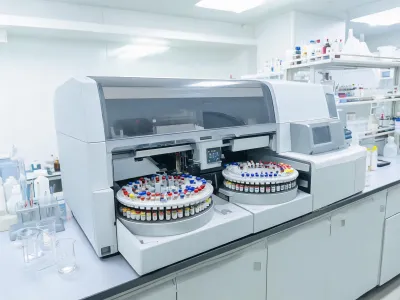 Immunoassay Platforms
Match assay menu and reflex rules to volume; confirm CE mark under IVDR 2017/746 or FDA 510(k) cleared status by reference.
Open catalog →
Immunoassay Platforms
Match assay menu and reflex rules to volume; confirm CE mark under IVDR 2017/746 or FDA 510(k) cleared status by reference.
Open catalog →
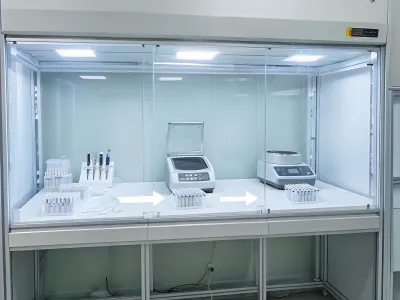 Molecular Diagnostic Suites
Document LOD/LoQ, contamination zoning, and IEC 62304 software lifecycle evidence for result algorithms.
Open catalog →
Molecular Diagnostic Suites
Document LOD/LoQ, contamination zoning, and IEC 62304 software lifecycle evidence for result algorithms.
Open catalog →
Why laboratory teams shortlist lean systems
Nominal tests/hour only matter when the morning panel mix, rerun rate, and autoverification rules are modeled together.
Coefficient of variation targets must map to CLSI EP05 plans and Levey–Jennings review ownership on site.
Limit of detection claims need prevalence context so clinical review does not drown in low-positive noise.
Orders, results, timestamps, operator ID, and downtime queues belong in the same interface acceptance packet.
ISO 13485 scope, ISO 14971 risk-benefit analysis, DHF/DMR access, and UDI labeling stay reference-specific.
Mean time between failures and mean time to repair only help when spare-parts SLAs and FSE coverage are written down.
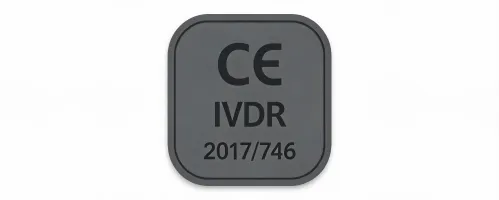
Each mark is a document request, not a blanket claim that every Nipro product shares one pathway. Prefer “FDA cleared” for 510(k) references; CE mark under IVDR 2017/746 for IVD.




Share care setting, expected volume, interface target, market, and decision date. No protected health information is required for the first reply.